The Retro Metropolis /* These styles allow the text to adapt to your website's Light/Dark mode automatically */ :root { --text-color: #1a1a1a; --bg-color: #ffffff; --accent-color: #0056b3; --quote-border: #000000; --meta-color: #555555; } /* Dark Mode Overrides */ @media (prefers-color-scheme: dark) { :root { --text-color: #e0e0e0; /* Bright white-grey for readability */ --bg-color: #121212; --accent-color: #4da3ff; --quote-border: #ffffff; --meta-color: #a0a0a0; } } body { background-color: var(--bg-color); /* Matches your theme */ color: var(--text-color); margin: 0; padding: 20px; } article { font-family: -apple-system, BlinkMacSystemFont, "Segoe UI", Roboto, Helvetica, Arial, sans-serif; line-height: 1.8; /* Increased slightly for better dark mode reading */ max-width: 800px; margin: 0 auto; } h1 { margin-bottom: 0.5rem; letter-spacing: -0.02em; } .subtitle { font-size: 1.25rem; color: var(--meta-color); font-style: italic; margin-bottom: 2rem; font-weight: 400; } hr { border: 0; border-top: 1px solid var(--meta-color); opacity: 0.3; margin: 2rem 0; } strong { font-weight: 700; color: var(--text-color); } .highlight-box { border-left: 4px solid var(--quote-border); padding-left: 1.5rem; margin: 2rem 0; font-style: italic; font-size: 1.1rem; color: var(--meta-color); }
The Retro Metropolis: Why New York Feels Analog in a Mumbai Minute
While the West clings to credit card rails built in the 1970s, India’s street economy has quietly leapfrogged into a friction-free digital future.
This is a tale of two cities, told through the purchase of a morning caffeine fix.
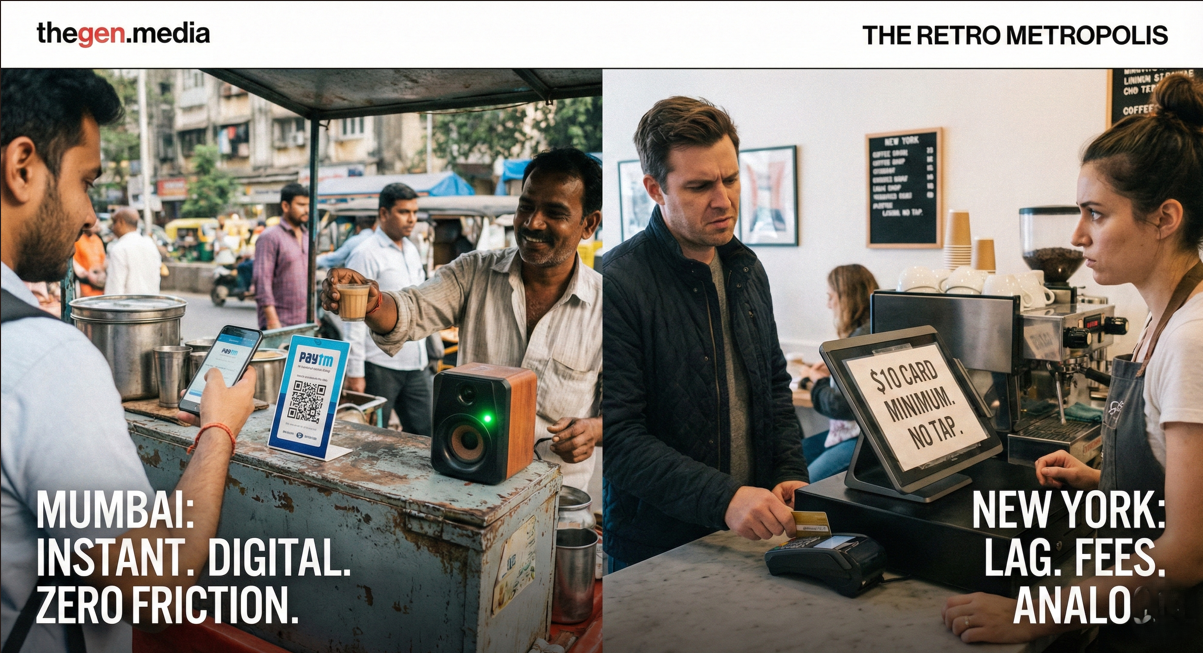
In Midtown Manhattan, buying a $6 latte is an exercise in accumulated friction. You tap a plastic card issued by a private bank against a terminal leased by another private entity.
Then, the wait. There is a three-second delay—the infamous "chip dip" lag—as information travels through legacy copper wires to verify if you are good for the money. You face an awkward digital tablet flipping around, demanding a 20% tip for handing you a cup. The merchant, meanwhile, quietly eats a 3% "interchange fee" for the privilege of accepting your money.
Five thousand miles away, on a humid street corner in Mumbai, a different transaction takes place.
A blue-collar worker stops at a roadside stall for a cutting chai, priced at ₹10 (about $0.12). There is no card machine. There is no cash register. There is only a laminated piece of paper tied to a tent pole with twine, displaying a black-and-white QR code.
The customer scans it with a budget Android smartphone, types in "10", and a split second later, a robotic voice from a small speaker box on the vendor's cart announces: "Paytm par dus rupay prapt hue" (Ten rupees received).
Transaction complete. Zero friction. Zero fees. Instant settlement.
For a global generation raised on the assumption that "developed" nations define technological modernity, landing in India today offers a jarring counter-narrative. The prevailing aesthetic of Western financial tech—the sleek Apple Card, the Venmo balance—suddenly feels clunky, siloed, and expensive.
The Failure of the "Walled Garden"
To understand why buying a banana in Bangalore feels more futuristic than buying a bagel in Brooklyn, you have to look beneath the surface of the apps we use.
The US and European model of digital finance was built on top of pre-existing, profitable banking systems. When digital payments arrived, they were developed as private "walled gardens."
- If you have Venmo, you cannot easily send money to someone who only uses Cash App.
- Apple Pay is seamless, provided you own an iPhone and the merchant pays for an NFC terminal.
These systems are designed to be sticky and profitable for their owners, not universally accessible for the public. Furthermore, the Western model relies heavily on credit card networks—Visa and Mastercard. Every time you tap that card, a complex web of banks takes a slice of the pie. This "merchant discount rate" is why your local bodega in Queens has a handwritten sign saying "$10 minimum for card purchases."
The UPI Leapfrog
India, faced with a massive unbanked population and a chaotic cash economy, didn't have the luxury of iterating on legacy systems. They had to build something new.
Enter the Unified Payments Interface (UPI).
Launched in 2016, UPI is not an "app." It is a protocol—a digital public highway built by the government that private companies can drive their cars on. The genius of UPI lies in three factors that Western systems lack:
- Radical Interoperability: It doesn't matter which app you use. A Google Pay user can scan a PhonePe QR code, and the money moves directly from bank to bank. The apps are just skins; the plumbing is universal.
- Zero MDR (Merchant Discount Rate): The government decided that for small transactions, there would be zero fees for the merchant. This single policy is why the chai wallah adopted it. In the US, a 3% fee on a $1 sale is negligible. In India, on a ₹10 sale, a 3% fee eats the entire profit margin.
- The Sound Box of Trust: The real unsung hero isn't the smartphone; it's the cheap, battery-powered "sound box" found on millions of carts. In a country with varying literacy levels, the audible confirmation that the cash has hit the bank provided instant digital trust.
The Democratization of Capital
The visual impact of this shift is profound. Walking through an Indian bazaar today is like walking through a cyberpunk novel where high-tech meets low-life. You see flower sellers, cobblers, and auto-rickshaw drivers—segments of society historically excluded from formal finance—displaying QR codes next to marigold garlands and rusted tools.
"While the West argues over whether crypto is a viable currency (it isn’t for buying groceries), India has quietly onboarded 300 million people into the formal economy using a simple 2D barcode."
This isn't just convenience; it's economic enfranchisement. When a street vendor accepts digital payments, they create a data trail of their income. Suddenly, a micro-entrepreneur who was invisible to the banking system has a verifiable cash flow, allowing them to access credit and escape predatory loan sharks.
The New Retro
The West is now playing catch-up. The US Federal Reserve recently launched "FedNow" to enable faster payments, decades after similar systems went live in Asia. Europe is scrambling to create a unified interface.
But they are fighting entrenched corporate interests that profit from the friction. Meanwhile, in Mumbai, the QR code has become part of the urban furniture, as common as the pigeons at the Gateway of India.
It’s a stark reminder that innovation doesn't always trickle down from Silicon Valley penthouses. Sometimes, it bubbles up from the street, borne of necessity. The next time you’re waiting for a chip card to process in a London cafe, remember the Mumbai chai wallah. He’s already finished his transaction and is moving on to the next.