January 19, 2026
Everyone loves a Nintendo launch day. The polish, the whimsy, the satisfying click of new hardware—it’s a masterclass in dopamine. But as influencers flood your feed with cheerful "Switch 2" unboxings today, a nastier narrative is brewing in the comments sections and repair shops.
Beneath the shiny 4K veneer, Nintendo is quietly exploiting its most loyal fans with a two-pronged attack on consumer wallets that can only be described as "Greedflation."
We aren’t just talking about higher hardware prices. We are talking about broken promises and a tax on nostalgia.
Drift 2.0: The Hardware Betrayal
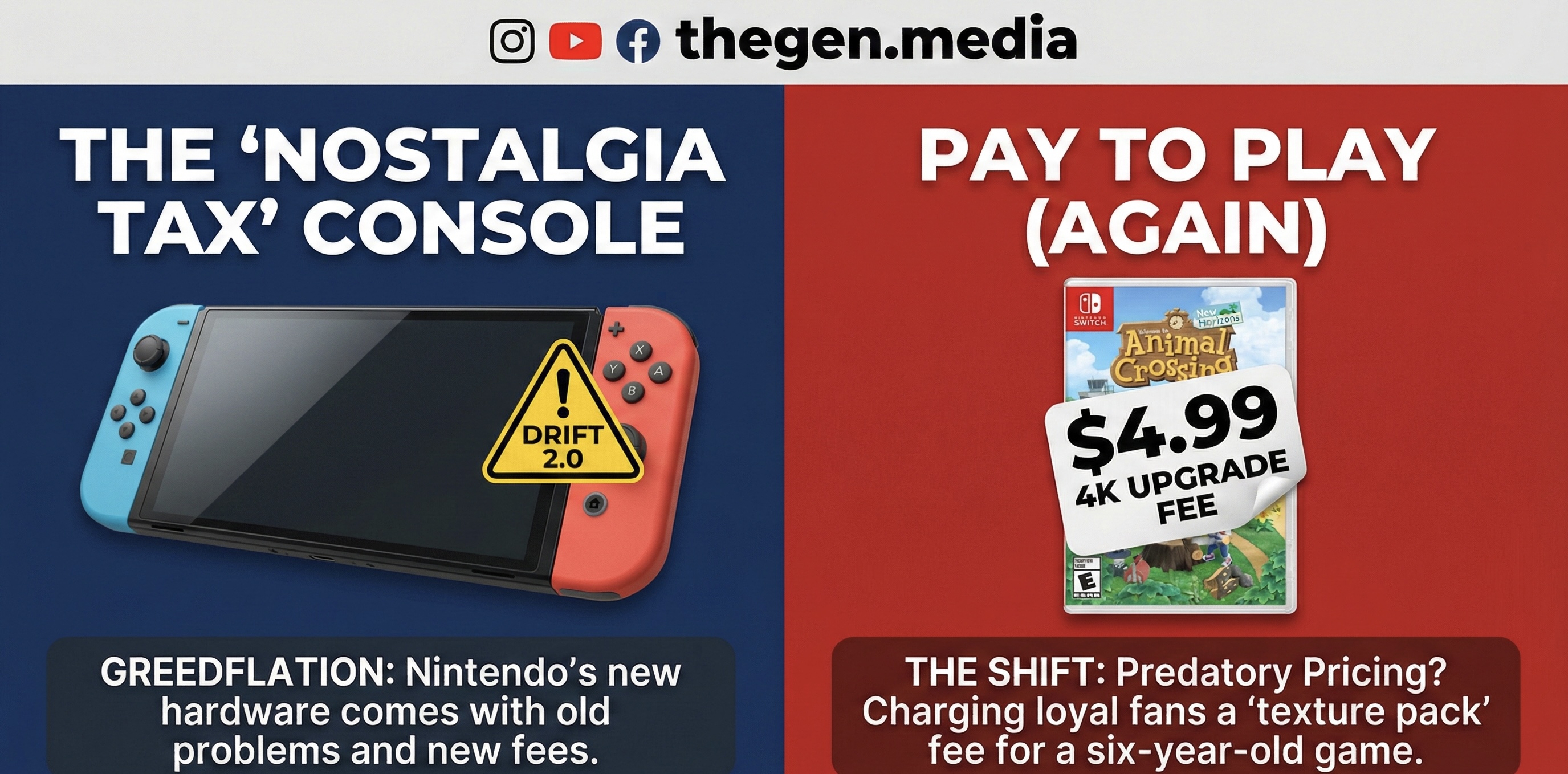
For six years, the "Joy-Con Drift" class-action lawsuit hung over Nintendo’s head like a storm cloud. Users rightfully expected the Switch 2 to be the silver lining. We expected Hall Effect sensors—magnetic sticks that never physically touch and therefore never wear out. It is the standard now used by many third-party controllers and competitors like the Steam Deck OLED.
Instead, confirmation came from iFixit’s recent teardown, which revealed a frustrating reality: The Switch 2 Joy-Cons still use potentiometer-based sticks.
This is a choice, not an accident. In an interview with Nintendo Life earlier this year, Nintendo executives confirmed the exclusion of Hall Effect technology, claiming the new "smooth-gliding" sticks were designed from the ground up.
But "smooth" doesn't mean "durable." By opting for friction-based mechanics effectively identical to the ones that caused the original scandal, Nintendo has ignored the plea of millions of gamers.
The $4.99 "Texture Pack" Insult
If the hardware feels cheap, the software pricing feels predatory. The most egregious offender is the new "Next-Gen Upgrade" for Animal Crossing: New Horizons.
In an era where other platforms often provide performance patches for free, Nintendo is charging a $4.99 (£4.19) fee to unlock 4K visuals and a "mouse mode" for a six-year-old game.
Let’s be clear: You aren’t paying for new content. You are paying a rental fee for the privilege of seeing a game you already own use the hardware you just bought. It is a "Nostalgia Tax"—a calculated bet that Gen Z’s emotional attachment to their 2020 comfort game is strong enough to override their financial common sense.
The Community Recoils
The backlash isn't hypothetical—it is happening right now on the platforms where Nintendo's most dedicated fans live.
On r/gaming, the mood has soured following the iFixit report. Users are expressing a weary acceptance that "Drift 2.0" is inevitable, noting that without the magnetic sensors, the graphite pads will eventually wear down just as they did in 2017. The consensus is that Nintendo’s repair programs are merely a "sorry-we-got-caught" measure rather than a genuine fix.
Meanwhile, the Animal Crossing upgrade fee has split the community on r/NintendoSwitch2. A highly upvoted discussion points out the absurdity of the pricing model: paying extra just to toggle settings that the hardware handles natively.
As one thread on the topic noted, charging for a resolution bump on a legacy title feels less like a service and more like "out-of-touch pricing" designed to see how much fans will tolerate. Even reviews from major outlets like Tom's Guide have hesitated to recommend the upgrade, noting that while the graphics are nice, charging existing owners for a performance patch is a "luxury" that competitors don't charge for.
The Verdict
Nintendo is banking on the fact that their IP is invincible. They believe Mario and Isabelle are enough to distract you from anti-consumer engineering and nickel-and-diming updates. But if today’s backlash is any indication, they may have finally overestimated the price of our nostalgia.
The Switch 2 might be a powerful console, but today, it feels like a powerful scam.