The Ocean Has a New Continent: How Plastic is Terraforming the High Seas
It’s no longer just a garbage patch. It’s a floating, breathing, aggressive new ecosystem—and it’s eating the locals.
The Pacific Ocean was never supposed to have solid ground.
For millions of years, the North Pacific Subtropical Gyre—a swirling vortex of currents between Hawaii and California—was an aquatic desert. It was the realm of the Neuston: fragile, jelly-like creatures like the blue sea dragon and the violet snail that drifted on the surface tension. There were no rocks, no reefs, and nowhere for coastal creatures to attach.
Then came the plastic.
In 1997, Captain Charles Moore discovered what we now call the Great Pacific Garbage Patch (GPGP). For decades, we viewed it as a passive environmental disaster—a shameful stain of floating bottles and ghost nets.
But new research has revealed something far more unsettling. The GPGP isn't just dead trash anymore. It has come alive.
Welcome to the "Neopelagic" Era
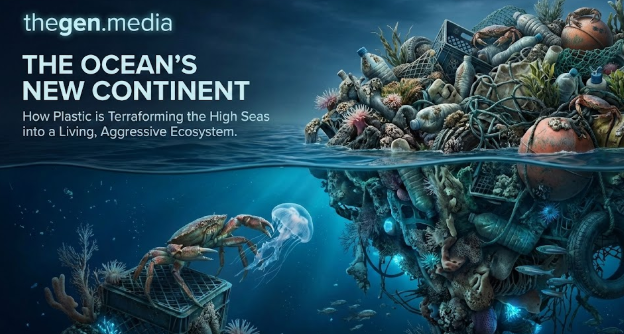
Recent studies, including a landmark paper in Nature Ecology & Evolution (April 2023), have confirmed a paradigm shift in marine biology. Scientists analyzing debris hauled from the patch by The Ocean Cleanup found that 70% of the plastic items were colonized by coastal species.
We aren't talking about weary travelers clinging to a life raft. We are talking about thriving colonies. Anemones, hydroids, amphipods, and crabs—creatures that biologically require a coast—are now living thousands of miles from shore. They are hunting, mating, and reproducing on a floating archipelago of toothbrushes, crates, and fishing buoys.
Scientists have coined a term for this new biological community:
-
Neo (New): Because this ecosystem has never existed in the history of the planet.
-
Pelagic (Open Ocean): Because it is happening in the most remote waters on Earth.
The Accidental Terraforming
In science fiction, terraforming involves altering a planet to support life. We have accidentally done this to our own ocean.
"The open ocean was once a wall that stopped coastal species from crossing continents. Now, it’s a bridge."
By pumping millions of tons of non-biodegradable hard surfaces into the gyre, we bypassed a fundamental evolutionary barrier. The plastic acts as a permanent reef. A plastic bottle lasts for centuries, long enough for generations of anemones to live and die on it. The GPGP is no longer just a "garbage patch"; it is a biological transport hub.
The data supporting this is staggering:
-
37 different coastal invertebrate taxa were identified living on the trash.
-
3x more coastal species were found on the debris than native open-ocean species.
-
It is now confirmed that these species are reproducing, creating a self-sustaining population.
The Cage Match: Plastic vs. Jelly
This new continent isn't peaceful. The arrival of coastal species is bad news for the locals.
The native Neuston species (the open-ocean surface dwellers) are evolutionarily unprepared for this. They are soft-bodied drifters. The invaders—coastal crabs and anemones—are armored, aggressive, and hungry. Evidence suggests the coastal hitchhikers are actively feasting on the open-ocean natives.
It is an ecological cage match, and thanks to our trash, the invaders have the home-field advantage.
The Future of the "Plasticene"
This phenomenon poses a terrifying question for the future: What happens when the raft hits land?
The GPGP is becoming a reservoir for invasive species. A crab from the coast of Japan can colonize a fishing net, drift to the patch, reproduce, and its offspring can hitch a ride on a bottle cap that washes up in California. We have effectively created a global conveyor belt for biological invasion, erasing the borders that keep ecosystems distinct.
As we look at the Great Pacific Garbage Patch today, we need to update our mental image. Stop picturing a floating landfill. Start picturing a floating jungle—a Frankenstein ecosystem built on the bones of our consumption, drifting slowly toward our shores.